
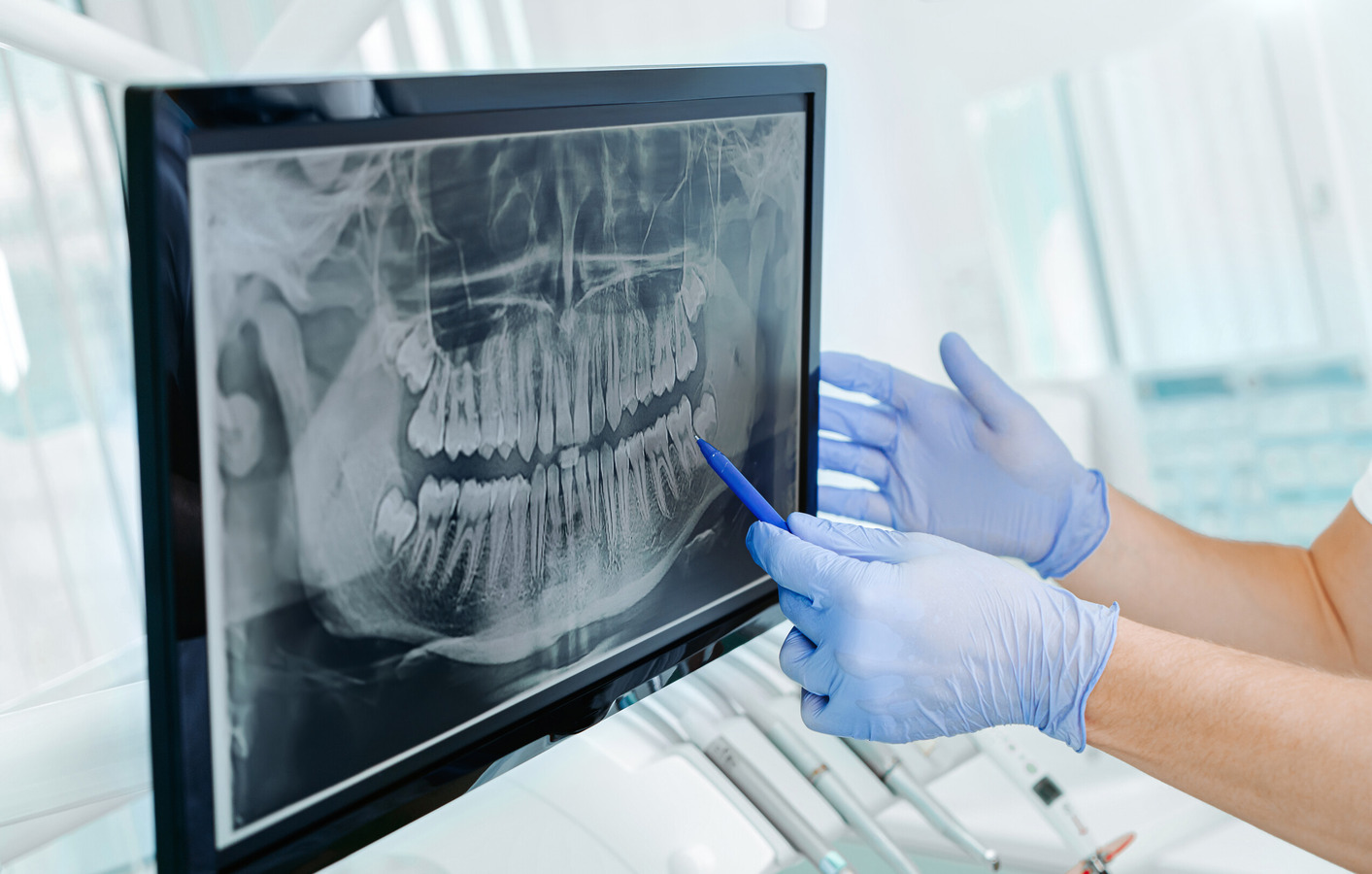
Are dental x-rays safe?
We understand the health concerns the public has about being exposed to radiation. That’s why the American Association of Orthodontists (AAO) has created this helpful guide to dental X-rays. Learn more about the different types of x-rays, their uses, why they are needed, what to expect from an x-ray treatment, what kind of radiation you will be exposed to, and what types of precautions our orthodontists take.
Why the radiation dose from dental x-rays is safe
- It is impossible to avoid radiation; on average, a person receives a dose of 1.7 millirem (a unit that measures the effective radiation dose, equivalent to 17 microsieverts) from natural background radiation daily.
- Dental X-rays expose patients to 0.1-.8 millirem of radiation, a very small amount (equivalent to 1-8 microsieverts)
- In comparison, dental x-rays usually expose patients to less than a daily dose of natural background radiation
- The benefits far outweigh the minimal risks; orthodontists need dental x-rays to see below the surface of the gums and create a plan for effective treatment
Radiation from dental X-rays is so minimal that an expert panel with the American Dental Association’s (ADA) Council on Scientific Affairs in 2024 updated national recommendations to say that protective equipment such as lead aprons and thyroid collars are no longer recommended. The amount of radiation is already so low that these extra layers are simply not necessary for your safety.
But isn’t radiation harmful?
When someone mentions the word “radiation,” it may conjure up images of nuclear weapons, deadly invisible forces that can melt skin or give you cancerous growths, apocalyptic wastelands, and strange, hideous mutations.
While it is true that ionizing radiation in very large doses can alter human cells, degrade DNA, increase the risk of cancer and other chronic diseases, and even lead to death, the amount of radiation that patients are exposed to during a routine dental X-ray is negligible.
In addition, X-ray technology has undergone significant improvements over the years. These days, digital x-rays are used to further reduce radiation exposure.
Digital technology used for dental x-rays:
- Requires less energy due to image enhancement on the computer
- Use a narrower beam size
- Use monitoring equipment to measure and fine-tune radiation exposure
- Can be programmed to lower radiation doses to the lowest possible necessity for a diagnosis
Finally, even though the amount of radiation you receive from your typical dental x-ray is minimal, many dentists still choose to continue using lead aprons or thyroid shields as an extra precaution to give patients peace of mind.
How “low” is a low radiation dose?
If your orthodontist has asked you to have x-rays taken, it is natural to be hesitant when either you or your child will be exposed to radiation.
Depending on the type of dental X-ray you receive, your average dental X-ray exposes you to between 0.1 and 0.8 Millirem of radiation, an extremely small dose.
Did you know that you are exposed to ionizing radiation from both Earth and cosmic background radiation? Just existing, breathing the air and eating food exposes the body to radiation. Essentially, you or your child cannot completely avoid radiation exposure. Actually United States Nuclear Regulatory Commission estimates that Americans are exposed to 620 millirems (equivalent to 6,200 microsieverts) annually. This means that you are exposed to an average of about 17 microsieverts per day from background radiation alone. A dental x-ray emits less radiation than what you normally receive from living your daily life.
Minimizing radiation exposure
Although radiation cannot be completely avoided, the goal is to minimize unnecessary radiation exposure so that your body does not need to absorb more than is considered healthy in a given period of time. The United States Nuclear Regulatory Commission has determined that a person who does not work with radioactive materials as part of their job must be exposed to not more than 100 millirem (equivalent to 1,000 microsieverts) of man-made radiation in addition to the average natural background radiation exposure per year.
100 millirem may not seem like a significant amount when you consider that the annual background exposure is about six times that. However, 100 millirem is a large amount of radiation. To put everything into perspective, you need to take more than 100 dental x-rays in a single year to maximize your safe man-made radiation exposure limit. No orthodontist would ever need close to 100 dental x-rays to create a treatment plan.
Why are dental x-rays necessary for orthodontics?
A question that many of our dentists often get is whether a dental x-ray is necessary for orthodontics. The answer is a clear yes.
You cannot get orthodontics without a dental x-ray, and our dental x-ray doctors will not offer treatment without the patients first having a dental x-ray taken.
Dental X-rays are essential for orthodontics because they let the dentist see what is going on beneath the surface of your teeth and gums that a simple visual examination or even a 3D scan cannot reveal. Specifically, X-rays help orthodontists:
Assess tooth position and development: X-rays show the exact alignment of teeth, root development, and whether any teeth are impacted (stuck under the gums) or coming in at unusual angles.
Evaluate the growth and structure of the jaw: X-rays provide insight into the bones of the jaws and face and help diagnose skeletal problems such as overbites, underbites or asymmetries that braces or other orthodontic treatments need to address.
Check for missing or extra teeth: They identify congenitally missing teeth or extra (supernumerary) teeth which can affect the growth and development of the permanent teeth. Orthodontists can also use X-rays to assess the positions of wisdom teeth and predict how they will ultimately affect treatment.
Monitor dental and root health: X-rays can detect root resorption, cysts, or other problems that may affect long-term dental health, movement, or stability during treatment.
Plan safe, effective treatment: Accurate diagnosis from x-rays helps orthodontists develop a treatment plan that minimizes complications and maximizes long-term results. This is the ultimate purpose of dental x-rays and why our orthodontists insist on them.
Dental X-rays give orthodontists the full picture needed to safely move teeth, correct bite problems, and ensure your smile remains healthy and stable for years to come.
Trusting your oral health to the orthodontic experts at AAO
It is understandable to be concerned about exposing yourself or your family to radiation sources. After all, cartoons, movies, news reports, and popular media in general have hammered into our minds that not much good can come from exposure to radiation.
But we live in a radioactive world. Everything we do, from breathing to drinking water, involves some level of radiation exposure. This is not a new phenomenon either. Natural radioactive decay in the earth’s elements or in food emits ionizing radiation, which we cannot avoid. And while it is true that the harms of significant radiation exposure are well documented, the reality is that small doses of radiation are considered fine.
It is impossible to completely avoid radiation; the goal is to limit your exposure to only what is necessary. In the case of evaluating orthodontic treatment, it is absolutely necessary to obtain dental x-rays so that your dentist can see below the gum line and create an effective treatment plan that promotes a beautiful smile, healthy jaw and better tooth positions.
Ultimately, with the latest advances in dental x-ray technology, we can limit patient exposure to such small amounts that it is often not even equivalent to the amount you receive from daily natural background radiation. Our orthodontists and their teams are trained to minimize your exposure to radiation while maximizing your improved health through personalized orthodontic treatment plans.
Ready to start your treatment? Find an AAO orthodontist today!