
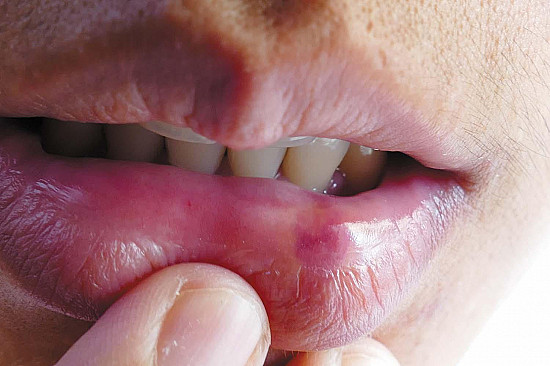
After reaching menopause, Marlene began to notice strange sensations in her lips. At first, they felt like they were sunburnt—raw and tingling—until sharp, stabbing pains began to pierce through the burn. Drinking wine or eating spicy food added to the distress, and Marlene now has lip balm close at hand to constantly dab on for brief relief.
The aptly named burning mouth syndrome affects about 2% of people, with women up to seven times more likely than men to be diagnosed — especially during the transition to menopause, according to the American Academy of Oral Medicine.
But it doesn’t necessarily involve just the lips. Burning mouth syndrome can also affect the tongue, corner of the mouth, gums, inner cheeks and throat. As in Marlene’s case, burning pain may be associated with stinging, tingling, a sour or metallic taste, or the sensation of something crawling inside the mouth.
However, one thing tends to unite everyone with burning mouth syndrome: they feel alone. “Many of my patients ask, ‘Who else has this?’ But there are so many others like them,” says Dr. Piamkamon Vacharotayangul, an oral medicine specialist in the Department of Oral Medicine and Dentistry at Harvard-affiliated Brigham and Women’s Hospital. “For those with a severe case, their pain is constant—they’re bothered by it all the time.”
Risk factors
Burning mouth syndrome is thought to be a form of neuropathic pain, meaning that nerve fibers function abnormally and transmit pain despite no obvious trigger. But while it is clear that hormone decline during perimenopause and beyond plays a prominent role in women’s development of the disorder, researchers do not yet know why. To add to the mystery, hormone therapy usually doesn’t make a dent in symptoms.
But stress seems to be a factor. Dr. Vacharotayangul noticed this during the pandemic, when people of all ages and genders came to her clinic with newly emerging cases. Traumatic events such as the loss of a job or the death of a loved one can also contribute. And people with burning mouths also suffer disproportionately from mood disorders such as anxiety or depression, she says.
Others may also cope with conditions such as temporomandibular joint (TMJ) problems, chronic fatigue syndrome or pain syndromes such as fibromyalgia.
“Burning mouth syndrome seems strongly related to stress and anxiety,” says Dr. Vacharotayangul. “And although it’s not always well known, hormonal changes in women can be very difficult to go through. It can be the cherry on top of everything else going on.”
Find relief
Adding to the conundrum, there is no diagnostic test for burning mouth syndrome. Doctors must first rule out other potential causes of symptoms, including yeast infections in the mouth, which can also cause burning; an inflammatory condition called lichen planus, which can involve painful mouth ulcers; or dry mouth, which may be due to medication use or other causes.
The trial-and-error approach continues even after burning mouth syndrome is confirmed. There is no cure and no standard approach to treatment, but a variety of medications and non-medical measures can help.
Dr. Vacharotayangul’s first-line choice is typically easy to find: alpha-lipoic acid supplements, which can help normalize nerve signals. She recommends taking 300 milligrams twice a day.
Another simple approach involves gargling with tabasco sauce dissolved in water, which takes advantage of the ability of capsaicin—the active component in chili peppers—to counteract burning mouth syndrome with a different type of burning sensation. “It helps by spreading molecules in the mouth that are used by nerves to create pain,” she explains.
A mouthwash containing clonazepam (Klonopin), a benzodiazepine typically used for anxiety or seizures, may also be effective. However, the drug must be prescribed with caution. “The age of the patient is a consideration,” she notes, “as it can increase the risk of cognitive impairment and falls in older people.”
Doctors may also use other nerve pain relievers such as gabapentin (Neurontin) or the antidepressant amitriptyline. And like Marlene, people with burning mouths can find temporary relief from topical creams or ointments, numbing products or mouthwashes. Some also sip cool water or suck on ice chips.
Stress management techniques such as mindfulness meditation and deep breathing are also worthwhile. “Two minutes of long, deep breathing has been shown to calm your system and can be very helpful,” says Dr. Vacharotayangul.
Image: © psisa/Getty Images