
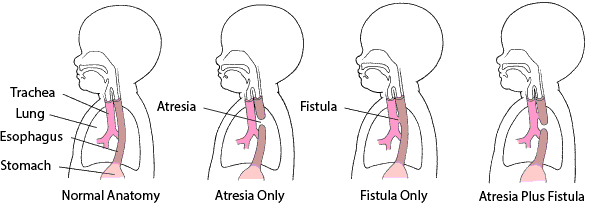
Esophageal atresia is one birth defect where the esophagus narrows or does not form completely. Most newborns with esophageal atresia also have an abnormal connection between the esophagus and windpipe (trachea) called a tracheoesophageal fistula.
The the esophagus is the long tube-like organ that connects the mouth to the stomach. In esophageal atresia, the esophagus is narrow or develops as two separate sections that do not connect (atresia). Because of the defect, food and liquids are delayed or prevented from passing from the esophagus to the stomach.
The trachea (trachea) is the main airway to the lungs. Normally, the esophagus and trachea are separate. In tracheoesophageal fistula, however, an abnormal connection (fistula) forms between the esophagus and trachea. Due to the defect, food and liquid enter the trachea and lungs.
Esophageal atresia and tracheoesophageal fistula often occur together.
Doctors do not know what causes esophageal atresia and tracheoesophageal fistula, but many children with these birth defects have other abnormalities, such as defects in backbone, heart, kidneys, genitals, earsand limbs and abnormalities in mental development, physical development, or both.
(See also Overview of birth defects in the digestive tract.)
Atresia and fistula: Defects in the esophagus
Symptoms
A newborn with esophageal atresia coughs, chokes, and drools after trying to swallow while eating.
A tracheoesophageal fistula is dangerous because it allows ingested food and saliva to travel through the fistula to the lungs, leading to coughing, choking, difficulty breathing, and possibly a lung infection called aspiration pneumonia (due to inhalation of food or saliva). Food or fluid in the lungs can impair the oxygenation of the blood, which can lead to a bluish discoloration of the skin (cyanosis).
Diagnosis
-
Before birth, prenatal ultrasound
-
After birth, passage of a tube down the esophagus and x-rays
Doctors may suspect esophageal atresia and tracheoesophageal fistula before birth based on results of prenatal ultrasound or after birth based on the infant’s symptoms.
If doctors suspect these defects after birth, they try to pass a tube down the infant’s esophagus. If the passage of the tube is blocked, they take X-rays to confirm the diagnosis and to localize the problem.
Doctors may do other imaging tests, such as a computed tomography (CT) scan, magnetic resonance imaging (MRI), or an esophagogram to further evaluate the defect and help them plan how to repair it.
Treatment
Before surgery to repair the defects can be performed, preparations are made to prevent complications such as aspiration pneumonia. First, oral feeding is stopped and a tube is placed in the infant’s upper esophagus to continuously suck saliva before it can reach the lungs. The infant is then fed via vein (intravenously).
Surgery must be performed shortly after birth to establish a normal connection between the esophagus and stomach and to close the fistula.
Some complications may develop after surgery. Leakage and scar tissue at the site where the esophagus was reattached are the most common problems. Many children have difficulty eating. Some children who have feeding difficulties thrive gastroesophageal reflux (backward movement of food and acid from the stomach into the esophagus) so doctors can give drugs that suppress stomach acid to newborns who had esophageal atresia. If the medication does not control the reflux, a procedure called fundoplication is performed. In fundoplication, the surgeon wraps the top of the stomach around the lower end of the esophagus to make this connection tighter and reduce reflux.