
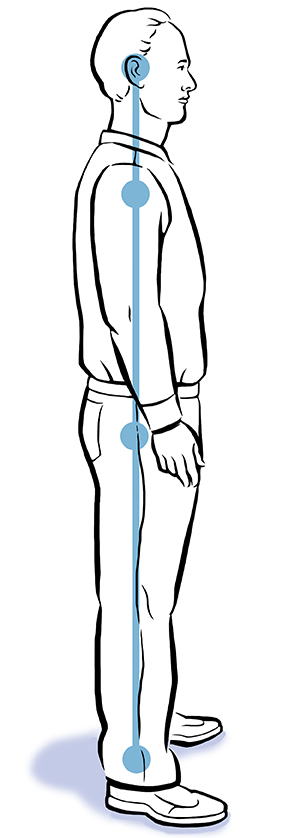
Protecting your neck from injury and pain involves practicing good posture and body mechanics. This may mean correcting bad habits you have related to the way you hold and move your body. The tips below can help you improve your posture and body mechanics.
What is posture and why does it matter?
Posture is the way you hold your body. For many people, this means bending over, thrusting the chin forward and lowering the shoulders. But this type of poor posture prevents the muscles from supporting the neck properly and puts stress on the muscles, discs, ligaments and joints in your neck. As a result, injuries and pain may occur.
How is your posture?
Use a full-length mirror to check your posture. To begin, stand normally. Then slowly back up against a wall. Is there space between your head and the wall? Are you slouching your shoulders? Does your chin point up or down? All of this can lead to neck tension and pain.
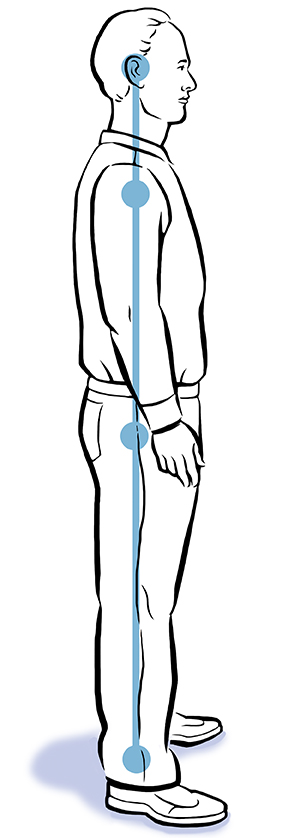
Improving your posture
Follow these steps to improve your posture:
-
Pull your shoulders back.
-
Think of ears, shoulders and hips as a series of dots. Now align your body to connect the dots in a straight line.
-
Keep your chin level.
What is body mechanics and why does it matter?
The way you move and position your body during daily activities is called body mechanics. Good body mechanics help protect the neck. This means learning the right ways to stand, sit and even sleep. So do what’s best for your neck and practice good body mechanics.
Standing
To protect your neck while standing:
-
Carry objects close to your body.
-
Keep your ears and shoulders aligned while standing or walking.
-
To lower yourself, bend at the knees with a straight back. Do this instead of looking down and reaching for items.
-
Work at eye level. Do not reach over your head or tilt your head back.
Sitting
To protect your neck while sitting:
-
Adjust your workstation so that your screen is at eye level. Also use a document holder when viewing papers or books.
-
Keep your knees at or slightly below the height of your hips.
-
Sit up straight, with your feet flat on the floor. If your feet do not touch the floor, use a footrest.
-
Avoid sitting or driving for long periods of time. Take frequent breaks.
Sleeping
To protect your neck while you sleep:
-
Sleep on your back with a pillow under your knees or on your side with a pillow between bent knees. This helps align the spine.
-
Do not use pillows that are too high or too low. Instead, use a neck roll or pillow under your neck while you sleep to keep your neck straight.
-
Sleep on a mattress that supports you.
Use of mobile devices
How to protect your neck while using mobile devices:
Author: StayWell Custom Communications
Date of last annual review:1/3/2025