It’s a headline that’s sure to make people keep reading: Is Chocolate Good For You?
Almost everyone wants the answer to be yes, of course. But there is no simple answer to be swallowed whole. So, like a good chocolate bar, let’s break it into bite-size pieces.
Chocolate actually starts with the cacao bean, the seed of the fruit from a cacao tree. It contains fiber and natural compounds with antioxidant properties called phytonutrients. Fiber is great for the digestive tract and can lower the risk of heart disease and certain cancers, while antioxidants are thought to help the body resist heart disease, cancer and other diseases.
Crushed and roasted, the cocoa bean becomes cocoa, the basic building block of chocolate.
The idea of cocoa as a key to health is not new. The Mayans and Aztecs believed cacao to be a gift from the gods and used it for healing and for rituals. The cacao tree is native to the Americas, but when Europeans heard about it, they quickly caught on. The Florentine Codex, written in the 16th century by a Spanish monk describing life in the New World, was just the first of many reports that informed Europe of cocoa’s medicinal benefits.
More recently, studies have suggested that cocoa consumption may help with heart health factors such as blood pressure and cholesterol, and may increase artery health, vision and brain function.
So do you put down the celery and reach for a chocolate bar? Not so fast.
“Hopefully I won’t give an answer that’s too depressing,” said Dr. Deepak L. Bhatt, director of Mount Sinai Foster Heart Hospital in New York City. “I’m a chocolate lover, but I don’t kid myself that I do it for anything other than giving myself a treat.”
The reason is all too clear: to transform bitter cocoa powder into delicious, irresistible chocolate, we add sugar and fat.
“That means extra calories and saturated fat,” said Haley Kanada, a registered dietitian nutritionist with UC Davis Health in Sacramento, California. “So it’s important to stick to a portion size to prevent weight gain and balance it with a healthy diet.”
Of all the research suggesting possible links between cocoa and heart health, Bhatt said he is most influenced by the Cocoa Supplement and Multivitamin Outcomes Study, or COSMOS, a large 2022 survey published in the American Journal of Clinical Nutrition. In a randomized clinical trial, more than 20,000 older adults were given either a capsule containing cocoa extract or a placebo daily, and then tracked for a median of 3.6 years.
The researchers reported that the cocoa extract did not significantly reduce cardiovascular events, but reduced cardiovascular death by 27%. They said a longer follow-up was needed to examine the difference.
“The gold standard in science is to do randomized placebo trials,” Bhatt said. That was done in the COSMOS trial, which showed no significant benefit, he said. If you dig down, some signals exist, Bhatt said, but “I don’t think those signals are enough to say you should take cocoa for cardiovascular health.”
But until sweeter research comes along, don’t expect our love affair with chocolate to cool. Nutritionists have long recommended that there is nothing terribly wrong with up to 2 ounces of dark chocolate daily. Canada suggests no more than 1 ounce per day. Dark chocolate is preferable to milk chocolate because it has more cocoa solids and less sugar – but the same number of calories. White chocolate also has no cocoa solids.
“Typically, the darker the better,” she said. “At least 70%, so you’re sure to get the benefits.”
Raw cacao or cocoa powder is too bitter to consume by itself, but they can be added to other foods for “some chocolatey flavor without adding actual chocolate,” Kanada said.
Try sprinkling some raw cocoa powder on oatmeal or fruit, or add it to your morning smoothie. “You get the chocolatey flavor and sweetness from the fruit, but you don’t get added sugar,” she said.
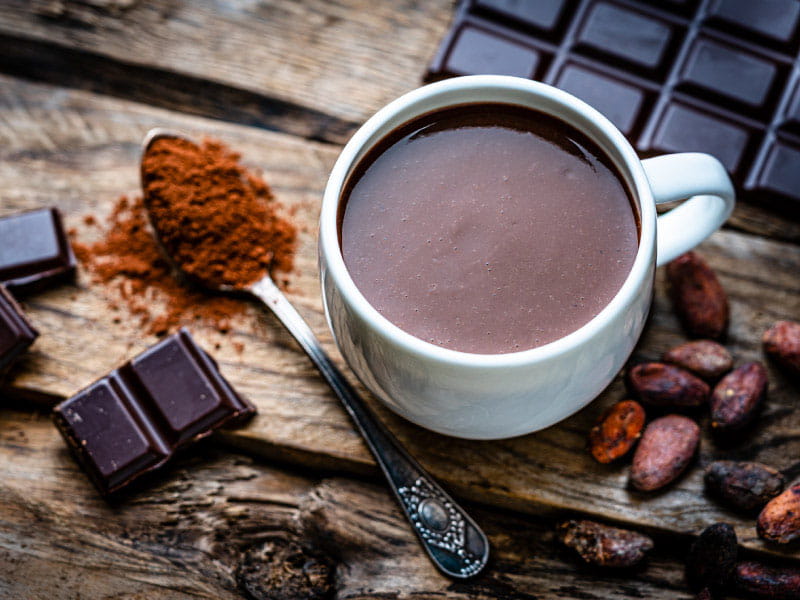
Want to sip a healthier hot cocoa? Kanada prescribes unsweetened almond milk, cocoa powder and a splash of maple syrup.
It can take some getting used to, she acknowledged, “but there are ways to get creative where you don’t have to rely on the packaged hot cocoa mix,” which has lots of sugar.
All this does not mean that chocolate does not promote other forms of health.
“To the extent that it makes people feel better,” Bhatt said, “it’s probably a good thing for mental health, but not really for cardiovascular health.”