
Overview
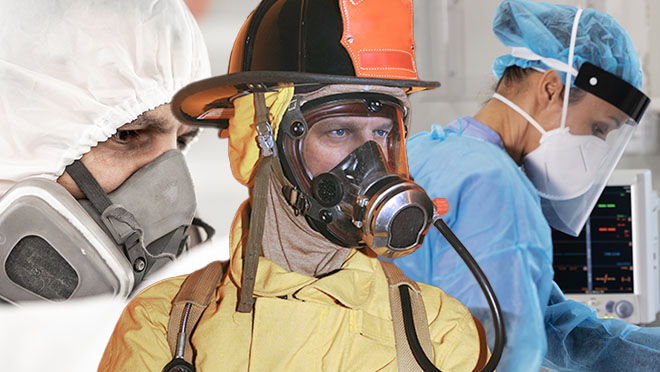
This page serves as a reliable source of information on respiratory protection. Millions of workers across the United States rely on respiratory protection to keep them safe on the job. This includes workers in occupations such as health care, construction, public safety, emergency response and mining.
To reduce exposure to respiratory hazards, it is best to use hierarchy of controls. The use of respiratory protection is an important “last line of defense” in the control hierarchy.
When an employer determines that workers need respiratory protection, the Occupational Safety and Health Administration (OSHA) requires the use of NIOSH-approved® respiratory protection. The NIOSH Respirator Approval Program is responsible for evaluating and approving respirators used in US workplaces.
Types
There are two main types of respirators. Each respirator type provides a different level of protection based on its design:
- Air Purifying Respirator (APR)
- Atmospheric self-contained breathing apparatus (ASR)
In addition, NIOSH approves five different types of APRs and ASRs for protection against chemical, biological, radiological and nuclear agents.
Each type of respirator has an assigned protection factor. This indicates the level of protection you can expect to receive from that respirator. Table 1 of the OSHA standard for respiratory protection presents the assigned protection factor for each respirator type.
It is important that employers choose the right type of respirator for your specific exposure or exposures. To do that, they need to identify all respiratory hazards in your environment and the amount of exposure.
In addition, the effectiveness of a respirator depends to a large extent on proper fit and use. For information on how to correctly select and use respiratory protection, see Selection and use of NIOSH approved respirators.
Air Purifying Respirator (APR)
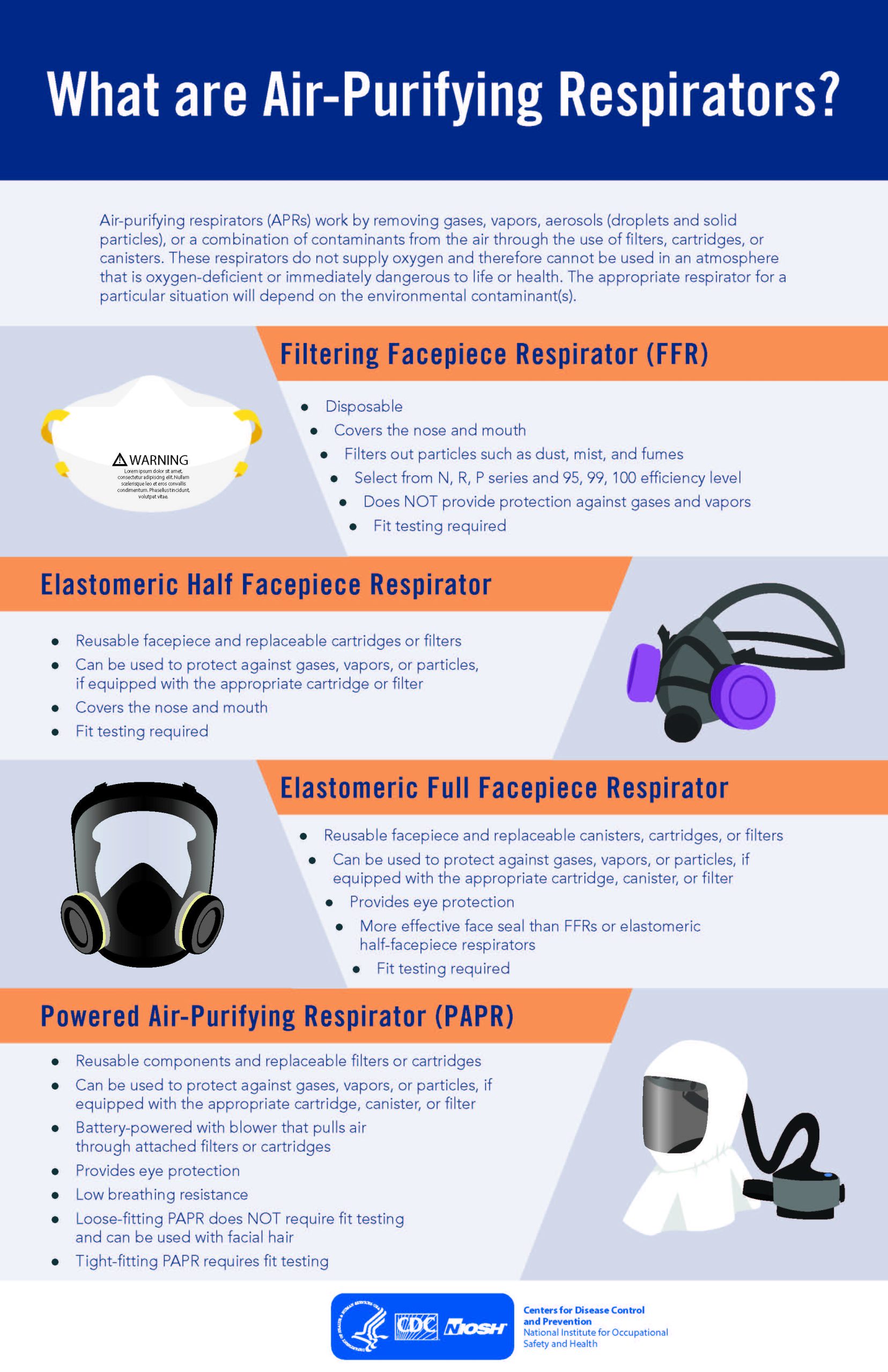
APRs use filters, cartridges, or canisters to remove gases, vapors, aerosols, or a combination of pollutants from the air. The different types of APR are
Atmospheric self-contained breathing apparatus (ASR)
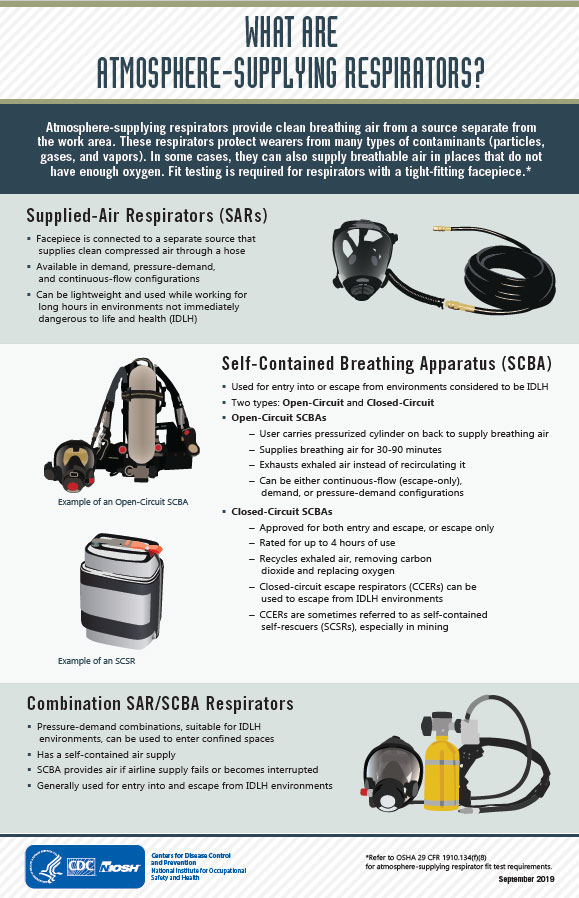
ASRs provide clean breathing air from a separate source. These respirators protect you from many types of airborne pollutants (particles, gases, and vapors) and, in some cases, oxygen-poor atmospheres. The different types of ASRs are:
- Respiratory protection with supply of air
- Self-contained breathing apparatus
- Open circuit (commonly used by firefighters)
- Closed circuit (used for entry or escape in industries such as mining where it is known as an independent self-rescuer)
- Combination air supply/self-contained breathing apparatus
Respiratory Protection Programs (RPPs)
Workplaces covered by OSHA must establish a complete RPP when respiratory protection is required.
RPPs typically have nine parts including medical evaluations, fit testing and training.
Medical assessments
What is the purpose of a medical assessment?
A medical assessment determines your ability to wear a respirator.
How often Do you need a medical assessment?
OSHA requires a medical evaluation once before the first fit test and use in the workplace. However, you may need a further evaluation if
- You, your supervisor, or your respirator program administrator recognize signs or symptoms that may affect your ability to use the assigned respirator.
- A licensed health care professional determines that you have a condition that causes you to need a new evaluation.
Adaptation test
What is the purpose of fit testing?
Fit testing ensures that tight-fitting respirators form a complete seal to the face, which is important to provide the expected level of protection. Conformance testing uses either a test tool qualitatively detected by the wearer’s sense of taste, smell or involuntary coughing (irritant smoke) or quantitatively measured with an instrument to verify the fit of the respirator.
How often should you be fit tested?
You should be fit tested annually and each time you use a different model, style or size respirator. If your weight changes or facial/dental changes occur, you may also need to undergo a fit test again to ensure your ventilator remains effective.
Training
What is the purpose of training?
Training ensures that you know how to use, clean and maintain your respirator correctly.
How often should the training take place?
You should receive training annually or when the need arises. A need may arise if the type of hazard level changes or if you use a new type or model of respirator.