

Stand Up, Stand Up: Fighting “Sitting Sickness”
Published it by Ava Sharifi. This entry was published in Staying healthy and tagged sitting sickness, Staying healthy. Bookmark permalink.
Over the past few years of working from home, ordering from home, and social distancing, many people are sitting even more than before the COVID-19 pandemic. Sitting is something so common that we often don’t realize how much of our day is really spent sitting still. But sitting for too long can have many negative effects on health and longevity.
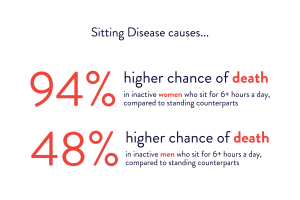
A study from 2011 in American Journal of Preventive Medicine found that prolonged sitting was associated with an increased risk of 34 chronic diseases, including obesity, diabetes, cancer and cardiovascular disease. Yikes!
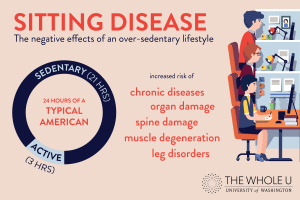
A typical American is sedentary for 21 hours out of the day. Including exercise and physical activity, people in the entire United States spend only about 3 hours out of the day standing.
This phenomenon has been coined “Sedentary Disease”, which is broadly defined as a condition of increased sedentary behavior associated with adverse health effects. Sedentary behavior can be defined by two things: the position you are in, which is generally reclining or sitting, and the amount of energy expenditure your body is experiencing.
You may be asking yourself, “But I exercise every day, does this still apply to me?”
Unfortunately, according to Journal of Medicine and Science in Sports and Exercisethe “Active Couch Potato” phenomenon states that even an active person who exercises five times a week still faces the risks associated with “Sedentary Disease” if they lead a sedentary lifestyle outside of the gym. Unfortunately, you can’t undo eight plus hours of sitting time with a workout!
Although it is recommended to engage in moderate to vigorous exercise 3-5 times a week, it is important to start with the first step: standing. Dr. Brian LiemMD, FAAPMR, of UW Sports Medicine, says that a “lifestyle of prolonged sitting is distinctly different, even from a lifestyle without routine exercise.”
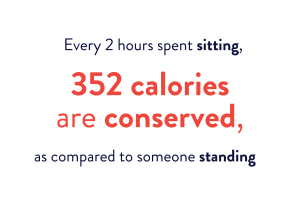
A study at the Mayo Clinic found that for every 2 hours spent sitting, 352 calories are saved compared to someone standing. Dr. Liem emphasizes that “standing can help get some of that metabolic activity back up because standing causes contractions in your postural muscles in your back, hips, and knees to keep you upright.”
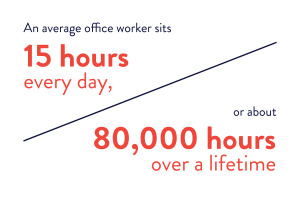
Most Americans stare at a computer screen throughout the day, whether at an office desk or at home. If not, we look at the computer in our pockets – our smartphones. The average office worker sits for 15 hours each day, which equates to around 80,000 hours spent sitting over a lifetime.
Technology has become an accepted part of our everyday lives, but that doesn’t mean we shouldn’t be aware of what our bodies are doing while using technology.
Staring at your computer with poor posture causes the development of a hump in your upper back, shortening of your hip flexors, shortened abs, a hollow chest, weakened shoulders, arm pain, numbness and tingling in your extremities, and worst of all, traumatic pressure on the discs in your back. All these symptoms are not uncommon.
Good posture is also important when using a smartphone because a human head weighs about 10-12 lbs. Studies show that if you bend your head down to the 60-degree typical texting position, your head can weigh about 60 lbs. We spend around 700 – 1,400 hours on our smartphones every year, so putting that much stress on our necks and spines just by bending our heads for that long can start to develop problems.
So what are some solutions?
We know that it is difficult to be removed from technology and that many common solutions can be expensive or difficult to find on the market. Instead, we emphasize the importance of awareness in relation to your posture, bodily movements and the amount of sitting/reclining per hour. day.
For every hour you sit, try to get about ten minutes of standing time. For every 30 minutes you work, there should be 20 minutes of actual computer work and then a 10-minute break. The 10-minute break should be 8 minutes standing and 2 minutes stretching. This alone is quite a change from sitting for hours, and over time should give back to your body exponentially.
Incorporate movement breaks into your day
Check out all the U’s Flex at your desk and Stretch at your desk handouts to learn a few moves that you can try at work. We also encourage you to do so Join The Whole U’s daily movement class at 11.00 15 minutes of stretching and light movement to give your body a much-needed break from sitting.
When sitting, think about ergonomic posture – bring your keyboard and mouse closer to your body, keep your shoulder blades pulled back, relax your elbows by your side and maintain a neutral spine. All the U’s Work with a better attitude handout is a good place to start.
Learn more by watching 2 recorded webinars
Work ergonomics with Dr. Peter Johnson
Join Dr. Peter Johnson, Professor Emeritus, Environmental and Occupational Health Sciences and Adjunct Professor of Industrial and Systems Engineering to learn everything you need to know about creating an ergonomic workspace – no matter where you work! Click here to download Dr. Johnson’s updated slides.
Sitting Disease Deep Dive with UW Sports Medicine
Elliot O’Connor, DPT, and Dr. Brian Liem of UW Sports Medicine shares information about what sitting disease is, how it can lead to chronic back and neck pain, and provides some simple exercises you can do to prevent and combat sitting disease.
Small steps can make a big difference – literally!
You can also fight “Sitting Sickness” through small things. Try parking farther away, standing while eating lunch, and balancing on one leg while watching TV or brushing your teeth. Every small step you take is one less moment spent sitting.
Next to standing, aerobic exercise is extremely important. As recommended by the HSS, you should perform at least 30 minutes of moderate-intensity aerobic activity approx. 5 days a week or 20 minutes of aerobic activity with high intensity approx. 3 days a week.