Rehabilitation medicine uses many forms of assistance, therapies, and devices to improve function. The type of rehabilitation a person receives depends on the condition causing the impairment, the body function affected, and the severity of the impairment.
The following are some common types of rehabilitation:1, 2, 3, 4, 5
- Cognitive rehabilitation therapy involves relearning or improving skills, such as thinking, learning, memory, planning and decision making, that may have been lost or affected by brain damage.
- Occupational therapy helps a person carry out everyday tasks and activities at home, at work and in the community.
- Pharmacohabilitation involves the use of substances to improve or restore physical or mental function.
- Physiotherapy involves activities and exercises to improve the body’s movements, sensations, strength and balance.
- Rehabilitative/assistive technology refers to tools, equipment and products that help people with disabilities move and function. This technology includes (but is not limited to):
- Orthotics, which are devices intended to improve movement and prevent contracture in the upper and lower limbs. For example, cushions inserted into a shoe, specially fitted shoes, or ankle or leg braces can improve a person’s ability to walk. Hand splints and arm wraps can help the upper limbs remain flexible and unbound after a spinal cord injury.
- Prostheses, which are devices designed to replace a missing body part, such as an artificial limb
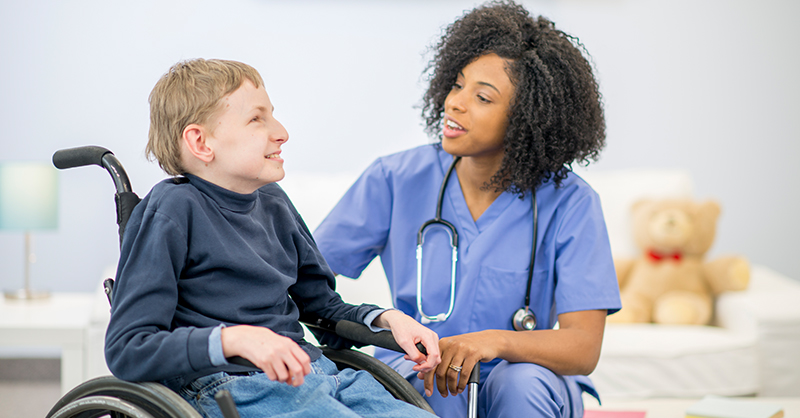
- Wheelchairs, walkers, crutches and other mobility aids
- Augmentative/Alternative Communication (AAC) devices, which are intended either to make a person’s communication more understandable or to replace a method of communication. They may include electronic devices, speech generating devices and picture boards.
- Hearing aids and cochlear implants
- Retinal prostheses, which can restore useful vision in cases where it has been lost due to certain degenerative eye diseases
- Telemedicine and telerehab technologies, which are devices or software to deliver care or monitor conditions in the home or community
- Rehabilitation robotics
- Mobile apps to help with speech/communication, anxiety/stress, memory and other functions or symptoms6
- Recreational therapy helps improve symptoms and social and emotional well-being through arts and crafts, games, relaxation training and animal-assisted therapy.
- Speech and language therapy aims to improve impaired swallowing and movement of the mouth and tongue as well as difficulties with voice, language and speech.
- Surgery include procedures to correct a misaligned limb or to release a tight muscle, skin grafts for burns, inserting chips into the brain to help move a limb or prosthesis, and placing skull plates or bone pins.
- Occupational rehabilitation helps build skills to go to school or work at a job.
- Music or art therapy can specifically assist in helping people express emotions, in cognitive development, or in developing social cohesion.7
These services are provided by a variety of health care providers and specialists, including (but not limited to):
- Physiatrists (also called rehabilitation doctors)
- Occupational therapists
- Physiotherapists
- Cognitive rehabilitation therapists
- Gait and clinical movement specialist
- Rehabilitation technologists
- Speech therapist
- Audiologists
- Orthopedists/surgeons
- Neurologists
- Psychiatrists/psychologists
- Biomedical Engineers
- Rehabilitation Engineers
Quotes
- NIH Clinical Center (2013). Rehabilitation medicine. Retrieved 21 August 2014 from http://www.cc.nih.gov/rmd/
- Medline Plus. (2013). Prosthesis. Retrieved 21 August 2014 from https://medlineplus.gov/ency/article/002286.htm
- University of Pittsburgh Medical Center. (2014). Intestinal rehabilitation. Retrieved 21 August 2014 from https://www.upmc.com/services/transplant/intestinal/rehabilitation

- Society for Cognitive Rehabilitation. (2013). What is cognitive rehabilitation therapy? Retrieved September 3, 2014 from https://www.societyforcognitiverehab.org/what_is_cognitive_rehab.php
- American Academy of Orthopedic Surgeons. (2014). Orthotics. Retrieved September 3, 2014 from https://orthoinfo.aaos.org/en/treatment/orthotics
- BrainLine.org. (2014). Life-changing mobile apps for people with brain injury. Retrieved 13 April 2015 from https://www.brainline.org/article/life-changing-apps-people-brain-injury
- National Rehabilitation Information Center. (2010). Art and music therapy in rehabilitation and beyond. Retrieved 20 April 2015 from http://www.naric.com/?q=en/content/art-and-music-therapy-rehab-and-beyond