
Background
Press release | What can be done
(January 2022)— These cards use data from Behavioral Risk Factor Surveillance System (BRFSS). CDC and state health departments are conducting the ongoing state-based telephone interview survey. This survey asked respondents whether they had performed physical activity outside of their regular work in the past month. People who said “no” were classified as inactive.
These maps use combined data from 2017 to 2020 for 52 jurisdictions:
- 49 states.
- District of Columbia.
- The territories of Guam and Puerto Rico.
Data for New Jersey were not reported because data were not collected in 2019. Combining 4 years of data made it possible to analyze physical inactivity among different racial and ethnic groups. Data from individual years is available via BRFSS.
Overall, the prevalence of physical inactivity was 25.3%.
Previous cards was released in January 2020 with data from 2015 through 2018. Two years in that analysis overlap with data in this analysis. Therefore, the two editions of maps should not be compared for trends.
Race/Ethnicity
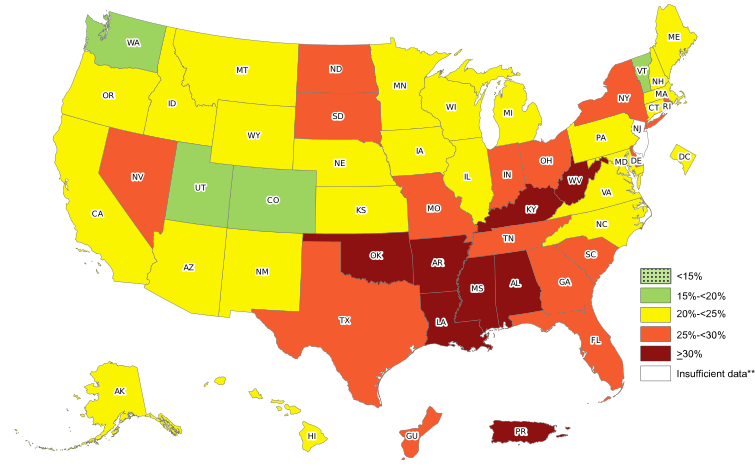
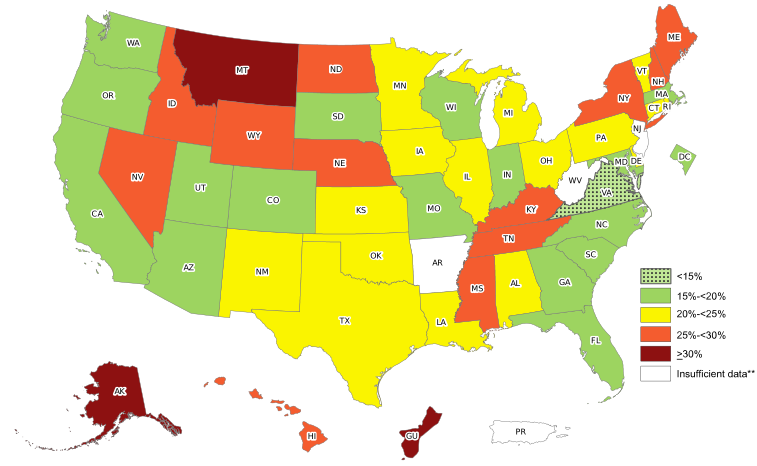
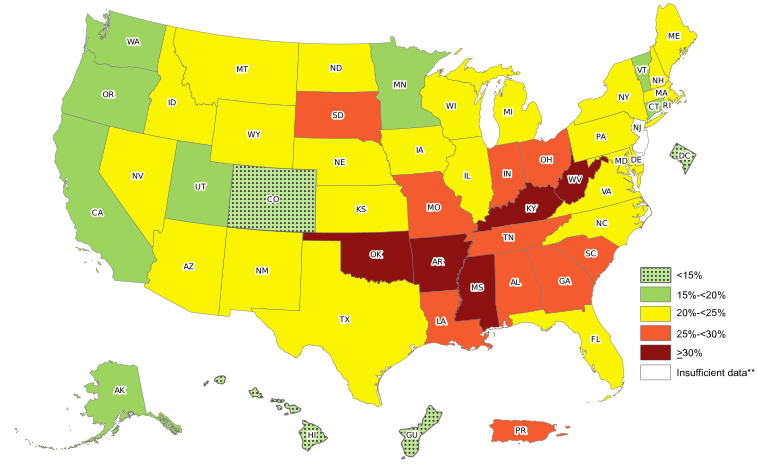
Overall, non-Hispanic Asian adults (20.1%) had the lowest prevalence of physical inactivity outside of work, followed by non-Hispanic whites (23.0%), non-Hispanic Native Americans/Alaska Natives (29.1%), non-Hispanic blacks (30.0%), and Hispanic or Hispanic/adults (3.2%).
- 2 states (Alaska and Montana) and Guam had physical inactivity rates of 30% or higher among non-Hispanic Asian adults.*
- 5 states (Arkansas, Kentucky, Mississippi, Oklahoma, and West Virginia) had physical inactivity rates of 30% or higher among non-Hispanic white adults.
- 27 states had physical inactivity rates of 30% or higher among non-Hispanic American Indian/Alaska Native adults.*
- 23 states and the District of Columbia had a physical inactivity prevalence of 30% or higher among non-Hispanic black adults.*
- 25 states and Puerto Rico had physical inactivity rates of 30% or higher among Hispanic or Latino/a adults.
*49 of 52 jurisdictions had sufficient data to be included in these results.
Physical activity can benefit allbut lack of access to safe and convenient places being physically active may contribute to these racial and ethnic disparities.
Location
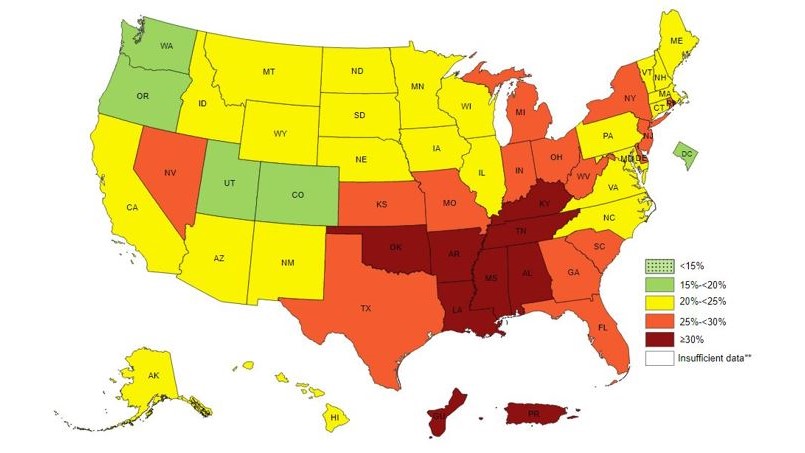
The lowest rate of inactivity outside of work was 17.7% (Colorado) and the highest rate was 49.4% (Puerto Rico). Regionally, states in the South (27.5%) had the highest rates of physical inactivity, followed by the Midwest (25.2%), Northeast (24.7%), and West (21.0%).
- 4 states (Colorado, Utah, Washington, and Vermont) had a physical inactivity prevalence of 17.7% to less than 20%.
- 24 states and the District of Columbia had a prevalence of physical inactivity of 20% to less than 25%.
- 14 states and Guam had physical inactivity rates of 25% to less than 30%.
- 7 states (West Virginia, Oklahoma, Louisiana, Alabama, Kentucky, Arkansas, and Mississippi) and Puerto Rico had physical inactivity prevalence of 30% or more.
What can be done
Reducing physical inactivity requires a comprehensive effort from many groups – including states, communities, workplaces and individuals – to make it easier for everyone to move more. Community leaders, for example, can encourage schools and youth physical activity programs and support design of actively friendly communities.
The racial and ethnic disparities in physical inactivity underscore the need to address barriers to physical activity for groups more likely to be inactive. Examples of barriers include lack of safe spaces for physical activity such as parks, unsafe streets with high-speed traffic and no sidewalks, lack of time, and lack of social support.
Everyone has a role to play to increase physical activity. Find out more about strategies to increase physical activity. Also, get involved in Active people, healthy nationSmCDC’s national initiative to help 27 million people become more physically active by 2027.
Individuals and families are encouraged to build physical activity into their daily routines. See recommended amounts of physical activity for persons aged 3 years and older.
Short: general physical inactivity outside of work
Prevalence of self-reported physical inactivity* among US adults by state and territory, BRFSS, 2017-2020
Source: Behavioral Risk Factor Surveillance System
* Respondents were classified as physically inactive if they answered “no” to the following question: “During the past month, apart from your regular job, did you participate in any physical activities or exercises such as running, exercising, golfing, gardening, or walking for exercise?”
** Sample size less than 50, relative standard error (standard error divided by prevalence) greater than or equal to 30%, or no data for at least 1 year.
Map: physical inactivity outside of work by race/ethnicity
Prevalence of self-reported physical inactivity* among US adults by race/ethnicity, state, and territory, BRFSS, 2017-2020
Non-Hispanic Asian Adults
Source: Behavioral Risk Factor Surveillance System
* Survey respondents were classified as physically inactive if they answered “no” to the following question: “During the past month, apart from your regular work, did you participate in any physical activities or exercises such as running, exercising, golfing, gardening, or walking for exercise?”
** Sample size less than 50, relative standard error (standard error divided by prevalence) greater than or equal to 30%, or no data for at least 1 year.
Non-Hispanic White Adults
Source: Behavioral Risk Factor Surveillance System
* Survey respondents were classified as physically inactive if they answered “no” to the following question: “During the past month, apart from your regular work, did you participate in any physical activities or exercises such as running, exercising, golfing, gardening, or walking for exercise?”
** Sample size less than 50, relative standard error (standard error divided by prevalence) greater than or equal to 30%, or no data for at least 1 year.
Non-Hispanic American Indian/Alaska Native Adults
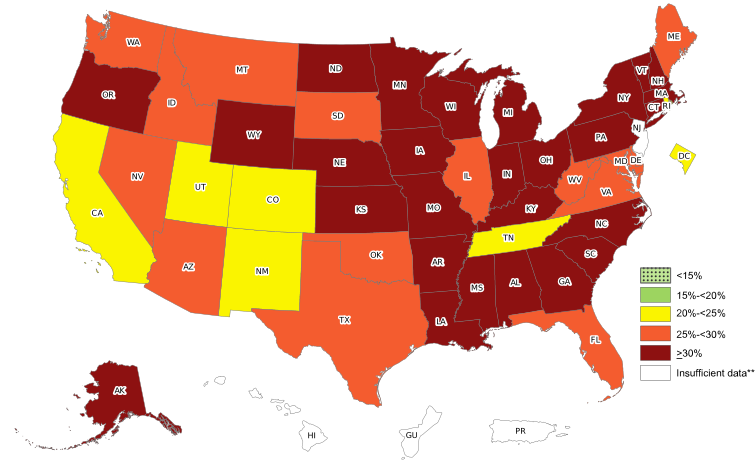
Source: Behavioral Risk Factor Surveillance System
* Survey respondents were classified as physically inactive if they answered “no” to the following question: “During the past month, apart from your regular work, did you participate in any physical activities or exercises such as running, exercising, golfing, gardening, or walking for exercise?”
** Sample size less than 50, relative standard error (standard error divided by prevalence) greater than or equal to 30%, or no data for at least 1 year.
Non-Hispanic Black Adults
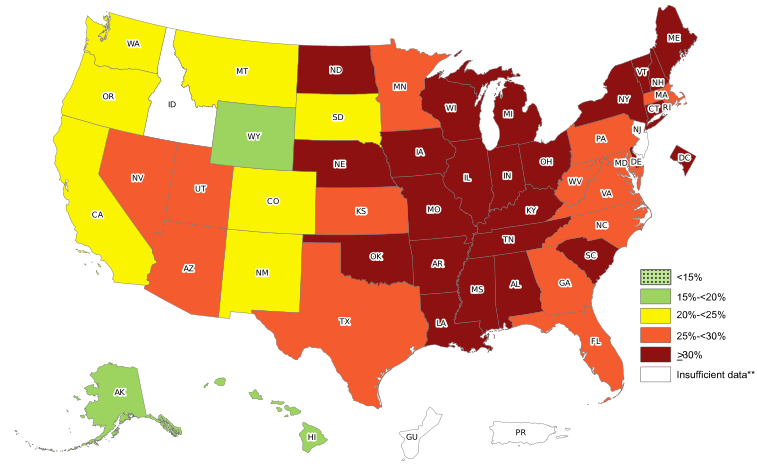
Source: Behavioral Risk Factor Surveillance System
* Survey respondents were classified as physically inactive if they answered “no” to the following question: “During the past month, apart from your regular work, did you participate in any physical activities or exercises such as running, exercising, golfing, gardening, or walking for exercise?”
** Sample size less than 50, relative standard error (standard error divided by prevalence) greater than or equal to 30%, or no data for at least 1 year.
Hispanic, Latino/a adults, or Hispanic adults
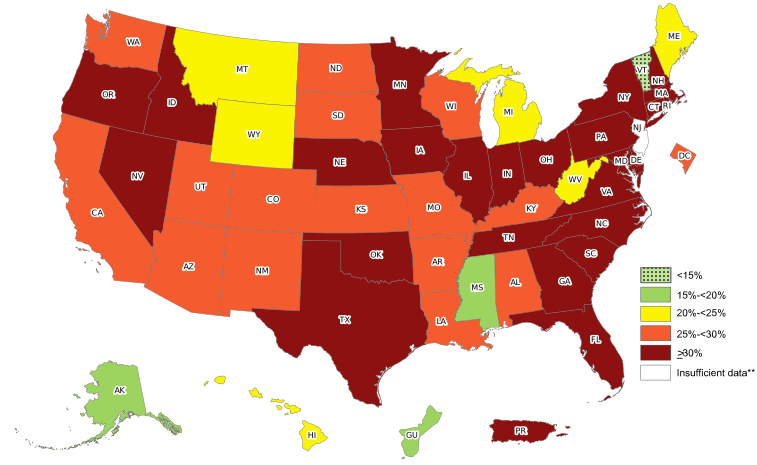
Source: Behavioral Risk Factor Surveillance System
* Survey respondents were classified as physically inactive if they answered “no” to the following question: “During the past month, apart from your regular work, did you participate in any physical activities or exercises such as running, exercising, golfing, gardening, or walking for exercise?”
** Sample size less than 50, relative standard error (standard error divided by prevalence) greater than or equal to 30%, or no data for at least 1 year.
Resources
Data, trends and maps
Interactive database of national and state data on Americans’ health status and behaviors. Includes physical activity and environmental and policy support for physical activity.
PLACES: Local data for better health
Model-based population-level analysis and community estimates for all US counties, places (incorporated and census-designated places), census tracts, and zip code table areas. Contains data on physical inactivity.
Health status data
Data sources to identify gaps in health.
Advances and new directions in physical activity monitoring
Journal of Physical Activity & Health supplement with up to 20 years of physical activity data. Articles include discussion of the history and future directions of national physical activity surveillance.
Physical activity across domains
Provides information on physical activity and inactivity that includes leisure, work/household and transport activities.